

Whether they fascinate you or creep you out, beetles are a massive group of insects that play an essential role in our Ontario ecosystems. In the urban garden, there’s no shortage of common species—but some tend to be more advantageous to us than others. Here’s a quick guide to the “good” and “bad” beetles (at least, from a gardener’s perspective!) that you’re likely to encounter in your yard.
What most people would consider your “garden variety” (no pun intended) bug—big, black, no obvious markings—fall under the category of ground beetles. These are an extensive family, which is good news since they’re working for us, not against us. Ground beetles are predators that go after a massive variety of garden pests—they’ll go after just about anything that might be troubling your garden. So, if you see one walking by, leave it be (and maybe say, thanks!).
One of the more adorable bugs on our list, you probably have no trouble spotting a ladybug! However, where many folks trip up is when spotting the juveniles, who look more like tiny black alien lobsters than the polka-dotted cuties we’re used to. If you spot a young ladybug, which has rust-coloured markings on a soft, elongated black body, don’t panic and squish it! The juveniles are actually hungrier and more effective at devouring aphids than their adult counterparts.

Soldier beetles are shaped like long rectangles with yellow or reddish bodies and a large black spot covering a large portion of their wings. Certainly one of the less-recognized garden bugs, these good guys are both effective aphid hunters and efficient pollinators! You can attract more soldiers to your garden by growing brightly coloured flowers—especially ones with compound blossoms like zinnias.
You might already be familiar with these invasive pests, which have destroyed thousands of acres of plant life across North America. It’s a bit of a shame that they are so bad for our gardens because they’re quite beautiful to look at; the shells are iridescent green and metallic copper with white spots along the edges.
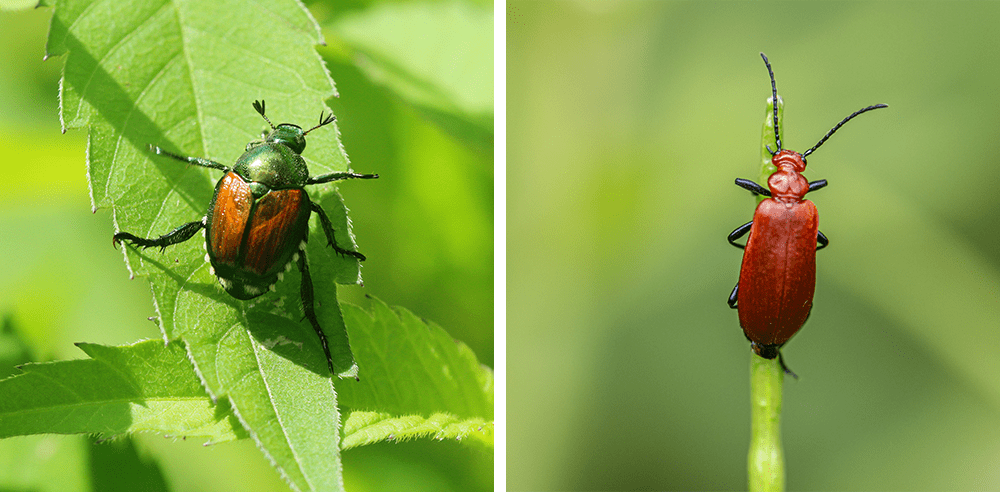
Lily growers especially should watch out for this bad guy. Not to be confused with the soldier beetle, red lily beetles are also elongated with rectangular bodies, but the shells are red, and the heads and limbs are black. They are incredibly destructive and can decimate a garden of lilies or fritillaries in a very short period of time. Once these guys find your lilies, you have few choices but to practice very diligent defense. Apply diatomaceous earth around the plants, and inspect them thoroughly every day. If you find these bad beetles, spray them with soapy water or hand-pick them and toss them into a pail of the same. Applying neem oil to your plants, focusing on the undersides of the leaves, can also help ward them off.
Thanks to their yellowish-orange bodies and black stripes, it’s not hard to recognize the Colorado potato beetle. However, despite their name, these bad beetles are not partial to potatoes alone—they’re also problematic for related garden crops like tomatoes, eggplants, and peppers. Fortunately, diatomaceous earth and neem oil are both effective at controlling them. The aforementioned soldier beetles and ladybugs are also keen to hunt potato beetle larvae—another reason to encourage those good beetles to stick around!

Another beetle that is as beautiful as it is bad news, the emerald ash borer, is an invasive insect that does exactly as its name suggests. The larvae cause enormous damage to ash trees by borrowing and devouring the layer between the bark and sapwood, leading to the death of entire trees. Don’t wait to spot one to practice prevention of this harmful bug; opt for kiln-dried firewood whenever possible, and burn firewood in the same area where you gathered or purchased it. Never move firewood to a new location as you can unknowingly be transporting these invasive beetles with you, giving them an opportunity to spread even further.

You’ll know exactly how they got their name as soon as you see them; tiny, shiny beetles that jump away from you like fleas. Fond of feasting on various vegetables and flowers, these little guys can be a real nuisance. Young garden plants are far more vulnerable to flea beetle damage. Many people have good luck with using floating row covers and applying diatomaceous earth to repel them until the plants are mature enough to survive an infestation.
Got some bad bugs running amok in your garden? At our Guelph garden centre, we can provide personalized recommendations on how to manage your bug problem with minimal impact to your yard’s biodiversity. Visit us today to find out how to get a better balance between your good and bad beetles!